
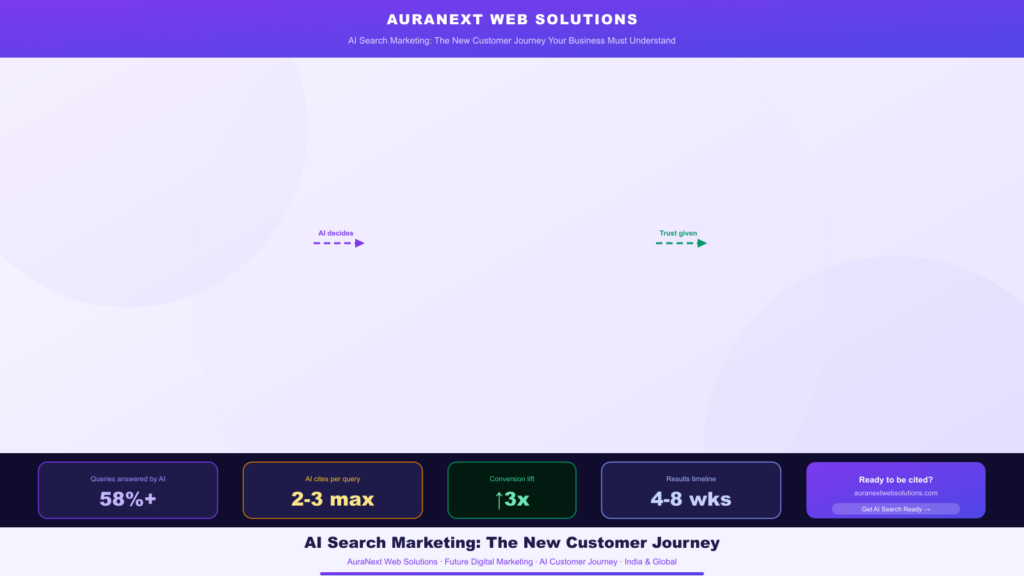
AI search marketing has rewritten the rules of how customers find, evaluate, and choose businesses — and most companies have not yet caught up. Think about the way your customers used to discover you. They typed a query, scanned a list of links, visited your website, read a few pages, and eventually reached out. Every step gave you a chance to impress them. Moreover, every step was one you could optimise.
Today, that journey has collapsed into a single moment. A potential customer asks an AI assistant one question. The AI reads hundreds of sources in seconds, selects two or three trusted ones, and delivers a ready-made answer. Your business either appears in that answer — or it does not exist to that customer at all.
In this guide, you will understand exactly how the AI customer journey works, why the traditional marketing funnel is no longer enough, and what future digital marketing looks like for businesses that want to stay visible. Furthermore, before reading this, it helps to review our earlier guide on how to optimize your website for AI search engines — this article builds directly on that foundation.
The Traditional Funnel vs the AI Search Marketing Funnel
For years, the marketing funnel followed a reliable path. Awareness arrived through rankings, ads, or social media. Consideration happened on your website. The decision followed after the customer read your content and checked your reviews. Consequently, every stage depended on the customer actively visiting your digital properties at each step.
However, the AI funnel compresses all of that into one moment. When a customer asks an AI assistant “which digital agency in Mohali is best for e-commerce,” the AI does not send them to ten websites. Instead, it evaluates reviews, authority signals, and structured content from across the web — then delivers a verdict. The customer’s consideration and decision now happen inside the AI, before they visit any website at all.
This is a fundamental shift. Furthermore, businesses that built their entire strategy around driving website traffic are now seeing that traffic decline — not because they lost rankings, but because the customer never needed to click.
What This Means for Your Marketing Budget
If you are spending money on content, ads, or SEO purely to drive clicks to your website, you are optimising for a journey that fewer customers are taking. Instead, the goal of modern AI search marketing is to become the source that the AI cites — so your brand appears in the answer itself. Our SEO marketing service is built specifically around this new reality.
Search, Chat, Recommendation: The New AI Customer Journey
Understanding the modern AI customer journey is essential for any business that wants to stay competitive. The journey now moves through three distinct phases — and each phase presents a different challenge.
Phase One — Search: The Trigger Has Not Changed, But the Destination Has
Customers still begin with a need or a question. That part has not changed. What has changed is where they take that question. Increasingly, customers go directly to an AI chat interface rather than a traditional search bar. In India, where mobile-first behaviour is dominant, this shift is especially rapid. Young urban consumers in Delhi, Bengaluru, and Mumbai are using voice assistants and AI tools for product comparisons and local service recommendations. Therefore, businesses that only optimise for traditional keyword rankings are missing a growing share of their potential audience.
Phase Two — Chat: Where the Real Decision Happens
The chat phase is where the AI customer journey diverges most sharply from the old funnel. In a traditional search, the customer had to do their own research — comparing options, reading pages, forming opinions. In the AI chat phase, the assistant does that work for them. It evaluates your credibility, checks your reviews, and reads your structured content. Consequently, if your business has weak authority signals or no schema markup, the AI recommends a competitor instead. The decision is made before the customer ever types your URL.
Phase Three — Recommendation: Trust Is Already Established
When a customer arrives through an AI recommendation, they are fundamentally different from a traditional organic visitor. They already trust you — because the AI vouched for you. As a result, conversion rates from AI-cited traffic tend to be higher. The customer is no longer exploring options. They are confirming a decision the AI helped them make. Our zero-click search guide explains how to maintain visibility even when customers never reach your website at all.
AI Assistants Are Becoming the Real Decision Makers
Here is the uncomfortable reality: in many purchasing decisions today, the AI assistant is the most influential voice in the room. Not your website. Not your sales team. Not your ads. The AI.
Consider a manufacturing business in Ludhiana looking for a logistics partner. Previously, the owner searched Google, visited several websites, and called three of them. Today, that same owner asks their AI assistant for a recommendation, receives two or three names with supporting reasons, and contacts the top suggestion directly. Furthermore, the businesses that never appeared in the AI answer — even with excellent services — never had a chance to compete.
This is why future digital marketing is no longer just about being found in search results. It is about being trusted by AI systems — and that trust is built through very specific signals.
The Signals That Make AI Trust Your Business
AI assistants evaluate businesses across several dimensions simultaneously. They check structured data — schema markup that clearly describes your services, location, and reviews. They assess topical authority — whether your website demonstrates genuine expertise on a focused set of topics. Additionally, they measure cross-platform consistency — whether your business name, address, and services match across your website and external directories. Our full-stack web development service builds all of these signals into your site architecture from day one.
How to Adapt Your Business for the AI Search Marketing Era
Adapting to AI search marketing is not about abandoning what you know. Instead, it is about layering new priorities on top of a solid technical foundation. Here is a practical, step-by-step approach that works for businesses across India and internationally.
Step One — Restructure Content Around Customer Questions
AI systems are question-answering machines. Therefore, every piece of content on your website needs to be built around the specific questions your customers actually ask. Start with your service pages. Rewrite each opening section to directly answer the most common question that page should address. For instance, instead of “We offer web design services,” write “A web design agency in Chandigarh typically delivers a complete website in four to six weeks, including design, development, and testing.” That is the kind of direct, useful answer an AI will cite. Our SEO in 2030 guide covers how this content architecture will evolve over the next few years.
Step Two — Build Cross-Platform Authority
AI assistants do not evaluate your website in isolation. They look at your entire digital footprint. Consequently, maintaining a consistent, authoritative presence across multiple platforms is no longer optional. Keep your Google Business Profile updated with current services and photos. List your business in relevant industry directories. Earn mentions and backlinks from credible regional publications. Each additional credible mention strengthens the signal that tells AI: this business is real, established, and trustworthy.
Step Three — Implement Structured Data Across Your Entire Site
Schema markup is the language AI systems use to understand your website quickly and accurately. Without it, an AI has to infer what your business does and who your customers are. With it, you tell the AI directly — and it can cite you with confidence. At minimum, implement LocalBusiness, Service, FAQ, and Review schemas across your key pages. Our SEO marketing service handles full schema implementation as part of every engagement.
Step Four — Earn External Citations
One of the strongest signals AI uses to determine trustworthiness is whether other credible sources mention your business. Guest articles in industry publications, being quoted in regional business news, and contributing expert insights to professional forums all build the external citation profile that pushes you into AI recommendations. Additionally, original research and genuine case studies are especially powerful — because AI systems prefer sources that contain information not found anywhere else. For technical guidance on building this authority, Google’s own E-E-A-T guidelines provide the authoritative framework.
A Real-World Example of AI Search Marketing in Action
Consider a mid-sized HR consulting firm in Delhi NCR that relied heavily on LinkedIn and Google for lead generation. When their team noticed AI Overviews appearing for queries like “best HR consulting firms in Delhi,” their brand was absent — despite strong traditional rankings. Their website had no schema markup, their content was written in corporate marketing language, and their Google Business Profile had not been updated in over a year.
After restructuring three core service pages, implementing FAQ and LocalBusiness schema, updating their business profile, and publishing two original case study articles drawing on real client outcomes, their brand began appearing in AI-generated answers within three months. Moreover, the enquiries that followed were noticeably better qualified — because the AI had already pre-screened the match between the customer’s need and the firm’s services.
This pattern repeats across industries. Whether you run a Shopify store, a legal practice, or a design agency, the AI customer journey is consistent. Businesses that understand it capture customers their competitors never see. Browse our client portfolio to see how we have applied these principles for real businesses.
Frequently Asked Questions About AI Search Marketing
What is AI search marketing and how does it differ from traditional SEO?
AI search marketing is the practice of optimising your business to appear in AI-generated answers, not just traditional search rankings. While traditional SEO focuses on ranking links on a results page, AI search marketing focuses on being cited by AI assistants like Google AI Overviews, ChatGPT, and Perplexity. The core difference is that AI systems evaluate trust, structure, and authority — not just keyword relevance — when deciding who to recommend.
Has the customer journey really changed that much?
Yes — significantly. Research shows that a growing proportion of purchase decisions now involve an AI assistant at some stage. In India, where mobile and voice search adoption is accelerating, the shift is especially rapid. Customers are increasingly using AI chat tools to get pre-screened recommendations rather than browsing multiple websites independently.
Do I still need traditional SEO alongside AI search marketing?
Absolutely. Traditional SEO and AI search marketing are complementary strategies. Strong technical SEO — fast pages, clean structure, quality backlinks — is the foundation that enables AI visibility. Furthermore, traditional search still drives significant traffic for transactional and navigational queries. The smart approach is to build both together, which is exactly how we structure every campaign.
Is AI search marketing relevant for small local businesses in India?
It is especially relevant for local businesses. AI assistants are increasingly the first stop for local service queries. Local businesses that build structured, authoritative local profiles benefit disproportionately because competition for local AI citations is far less intense than for national or global terms. The opportunity is significant and underutilised right now — particularly in cities like Chandigarh, Mohali, Jaipur, and Indore.
How quickly can I expect results from AI search marketing?
Initial improvements — such as appearing in AI Overviews for specific local queries — can emerge within four to eight weeks of targeted changes. Broader AI citation visibility typically develops over three to six months as authority signals accumulate. Start with a free SEO audit to understand exactly where your biggest opportunities are right now.
The Bottom Line: The Customer Journey Has Moved — Your Marketing Must Follow
The old funnel assumed customers would come to your website and evaluate you there. The new AI customer journey means customers are being evaluated for you — by an AI — before they ever visit your site. As a result, your marketing strategy needs to be built around earning AI trust, not just search rankings.The good news is that the steps are concrete and achievable. Restructure your content around real questions. Build cross-platform authority. Implement structured data. Earn external citations. Each action compounds over time, creating a visibility advantage that becomes harder for competitors to close as AI search continues to grow.
Ready to adapt for the AI search marketing era? Explore our SEO and digital marketing services, see how our full-stack development team builds authority-ready site architectures, or contact AuraNext Web Solutions today to take the next step.