
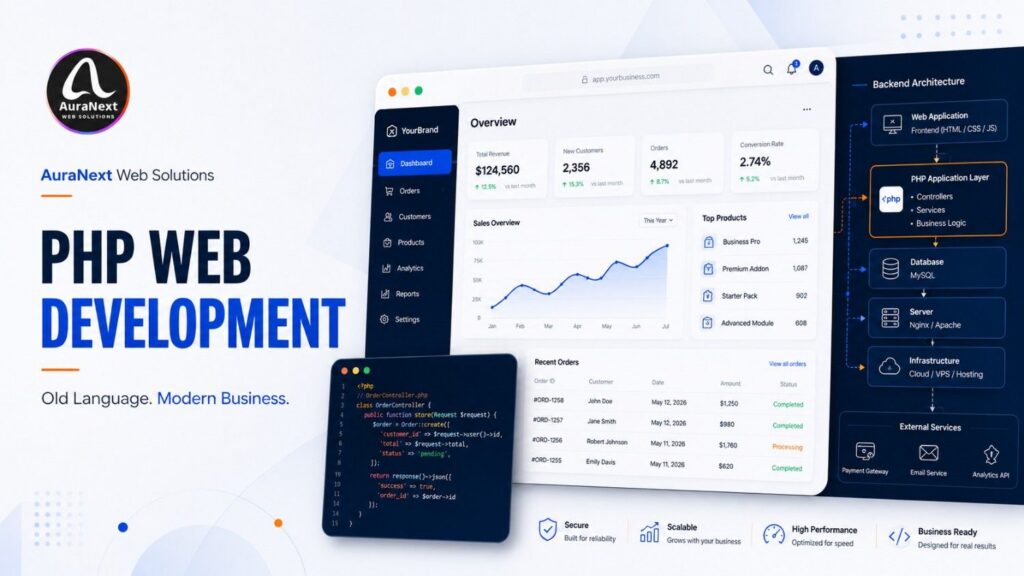
Ask around and someone will tell you PHP web development is outdated. Ask what they built recently, and often the answer is nothing — the opinion is inherited, not tested. Meanwhile, PHP continues to run a large share of the active web, quietly handling traffic most newer stacks have never been tested against at that scale.
This guide looks at what custom PHP development and PHP website development actually involve today, where Laravel fits, and when PHP genuinely is not the right fit either. If your project is Shopify-based instead, our Shopify development page covers that path specifically.
Custom PHP Development: Separating the Language From Its Reputation
A decade-old PHP script and current PHP share a name and little else. Modern PHP supports strict typing, clean object-oriented structure, and a mature package ecosystem through Composer. Judging today’s PHP by old code is like judging a car by a decade-old model with the same badge.
Reasons Businesses Still Pick PHP
- Hosting is everywhere: virtually every hosting provider supports PHP natively, keeping infrastructure costs predictable.
- Developers are easy to find: a deep, mature talent pool makes long-term maintenance simpler than niche stacks allow.
- It scales in practice: some of the highest-traffic platforms on the internet still run on PHP today.
PHP Framework Laravel: Usually the Best PHP Framework, Not Always
Laravel earns its reputation as the best PHP framework for most projects by handling routing, authentication, and database migrations out of the box. Its Eloquent ORM also speeds up database work considerably compared to writing raw queries by hand. Its official documentation is worth a look even if you are just evaluating whether it fits your project.
That said, a small internal tool with barely any logic does not always need a full framework. Sometimes lighter, plain PHP gets the job done faster and cheaper, and choosing Laravel there just adds overhead without adding value.
Secure PHP Development for Scalable Web Applications
Most PHP security concerns trace back to outdated versions or careless coding, not the language itself. Current PHP, combined with parameterized queries and regular dependency updates, holds up well under real-world attack attempts.
Scalable web applications also lean on PHP’s mature caching and queueing tools to absorb traffic growth without a rebuild. If your project needs deeper backend work beyond PHP alone, our full-stack web development team can extend it from there.
Frequently Asked Questions
Is PHP still worth using for web development in 2026?
Yes. PHP still powers a large portion of active websites, and current versions support the same practices found in newer languages.
What is the best PHP framework for a new project?
Laravel is the strongest general-purpose choice for most projects with real business logic. Very simple sites may not need a framework at all.
How do I choose between top PHP development companies?
Look for evidence of current, maintained work rather than only legacy projects. Whether you compare large firms or a smaller php website development company, ask which PHP version and framework they default to and why.
Final Word
PHP web development has stayed relevant because it is practical, not because it is fashionable. It hosts affordably, scales when built correctly, and gives you access to a wide, experienced developer pool. Pick it because it fits the project in front of you, not out of habit. Deciding between PHP and another stack for your next build? Talk to the AuraNext team for a straightforward recommendation based on your actual requirements.