
Most comparison guides on WooCommerce vs Shopify give you a feature checklist and call it a day. This one doesn’t. After working across both platforms with 500+ businesses — from early-stage brands to scaling e-commerce operations — there are patterns that clearly separate which platform wins for which type of business.
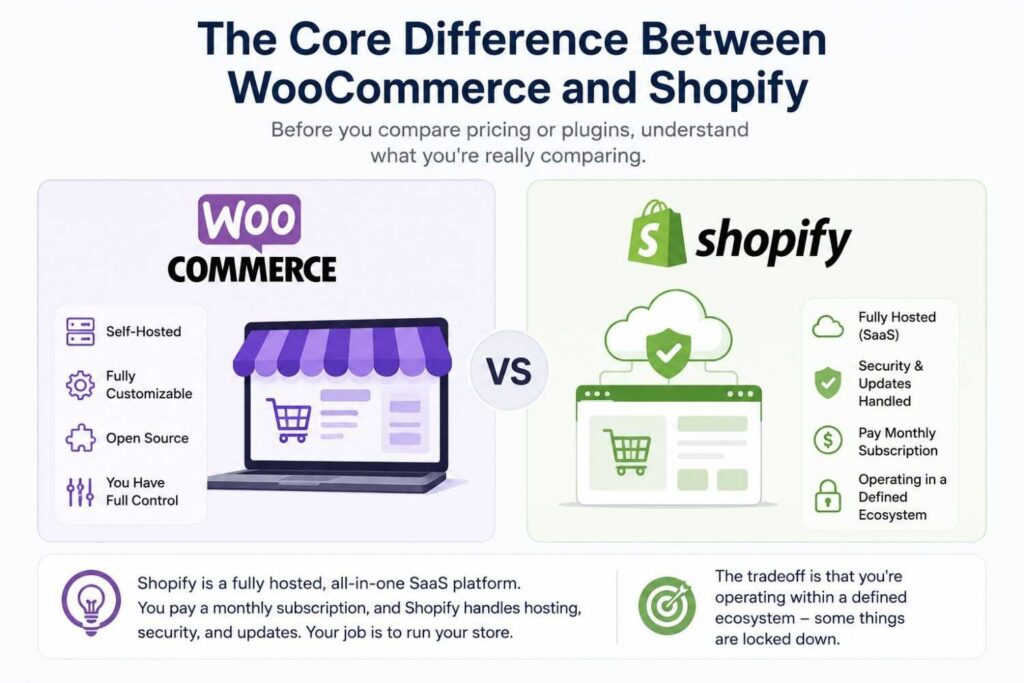
The Core Difference Between WooCommerce and Shopify
Before you compare pricing or plugins, understand what you’re really comparing.
Shopify is a fully hosted, all-in-one SaaS platform. You pay a monthly subscription, and Shopify handles hosting, security, and updates. Your job is to run your store. The tradeoff is that you’re operating within a defined ecosystem — some things are locked down.
WooCommerce is a free, open-source e-commerce plugin for WordPress. You control everything: your hosting, your data, your design, and your functionality. That flexibility is genuinely powerful — but it comes with responsibility. Someone on your team, or your development partner, needs to manage the technical side.
Understanding this distinction makes every other comparison more meaningful.
Shopify Pricing vs WooCommerce Pricing: What You’ll Actually Pay
Shopify’s 2026 pricing sits at $39/month (Basic), $105/month (Shopify plan), and $399/month (Advanced). These fees don’t include most apps, which commonly add another $20–$100/month depending on your stack.
WooCommerce is free to install, but your total cost includes:
- Managed hosting: ₹1,000–₹8,000/month depending on traffic and quality
- Premium plugins: varies by need, often ₹5,000–₹20,000/year
- Development or maintenance depends on your team setup
For businesses in India — including startups and D2C brands building from Mohali, Delhi, or Bengaluru — WooCommerce often has a lower barrier to entry. Shopify becomes more attractive when a business wants to eliminate technical overhead and pay a predictable monthly cost instead.
Neither platform is wasteful. It depends on what you want to achieve.
AuraNext WooCommerce Development Services helps businesses build flexible and scalable online stores with WooCommerce.
Shopify vs WordPress SEO: Where Each Platform Stands
SEO is often the deciding factor for content-driven brands, and the platforms behave differently here.
WordPress with WooCommerce is the stronger SEO environment by design. You have full control over URL structures, schema markup, sitemaps, breadcrumbs, and blog architecture. Plugins like Rank Math integrate deeply into the WordPress ecosystem and give you granular control that Shopify simply doesn’t match natively.
Shopify has significantly improved its SEO over the past two years, and stores built correctly on Shopify absolutely rank well. The limitations — like the fixed /collections/ and /products/ URL format, or the thin content challenge on filter pages — are real but manageable with the right approach.
If organic search is your primary acquisition channel and you plan to invest in content marketing long-term, WooCommerce on WordPress gives you the broader toolkit.
For an authoritative external reference, Google’s own guidance on e-commerce best practices for search is the clearest guide to what actually affects how your store ranks.
Where Shopify Wins
Speed and simplicity are Shopify’s strongest cards. If you’re launching a product-focused store and want to be live in days rather than weeks, Shopify’s theme system, integrated checkout, and app ecosystem make that genuinely achievable.
Shopify’s checkout is also one of the highest-converting in the industry. For brands where cart abandonment is a primary concern, the platform-level polish matters.
We work with clients on Shopify theme customization, checkout extensions, and app integrations — and when a brief calls for fast, high-converting, and low-maintenance, Shopify is hard to argue against. And if you already have a Shopify store and want to improve its theme, performance, or conversion structure, ourAuraNext Shopify services page walks through exactly how to do that in 2026.
Where WooCommerce Wins
WooCommerce wins on flexibility, content power, and total ownership. If your store requires custom user roles, complex product variations, multi-vendor features, or deep integration with third-party systems, WooCommerce can handle it without fighting platform limitations.
It’s also the stronger choice for businesses that run content as a core strategy — case studies, guides, tutorials, and SEO-rich blog content that drives consistent organic traffic. Because WooCommerce lives inside WordPress, your store and your content strategy live in the same place.
For Indian businesses, WooCommerce also integrates seamlessly with payment gateways like Razorpay, PayU, and CCAvenue without the additional transaction fees Shopify charges when Shopify Payments isn’t available. For a deep look at what WooCommerce stores and WordPress builds look like in practice, visit our WordPress/WooCommerce development page to see the platforms and approaches we work with.
Frequently Asked Questions
Is WooCommerce better than Shopify for SEO? WooCommerce gives you deeper SEO control, especially for content-heavy stores. It runs on WordPress, which has a much richer content and technical SEO ecosystem. Shopify is competitive for SEO but works best when your primary channel is paid traffic or direct.
What is the true cost difference between Shopify and WooCommerce? Shopify costs $39–$399/month plus apps. WooCommerce is free but requires hosting, plugins, and developer support. For early-stage businesses in India, WooCommerce typically costs less overall. Shopify becomes more cost-efficient when you factor in reduced technical management.
Can I switch from Shopify to WooCommerce? Yes, and it’s done regularly. A proper migration covers product data, customer records, URL redirects, and SEO preservation. Done wrong, it can cause traffic losses — so working with an experienced team matters significantly.
Which platform is better for Indian businesses? Both work well, but WooCommerce has a practical edge for Indian businesses because it natively supports Indian payment gateways without additional transaction fees, gives you full hosting control, and is more cost-efficient at lower revenue levels.
What are the best Shopify alternatives in 2026? WooCommerce is the most capable Shopify alternative for businesses that want control and flexibility. BigCommerce is a strong runner-up for larger catalogs. For completely custom solutions, a full-stack React-based storefront is increasingly an option for funded brands.
So Which One Should You Choose?
Here’s a simple way to think about it: if you want to run a store without thinking about servers, updates, or plugins — Shopify. If you want to own everything, have full SEO control, and build a content-powered brand — WooCommerce.
Neither decision is permanent. Migrations happen, and the right platform at launch isn’t always the right platform two years later.
What matters most is having a clear strategy before you build — not just picking a platform and hoping for the best.
If you’re not sure which fits your business, the team at AuraNext Web Solutions can give you an honest, no-obligation assessment. We’ve worked across both platforms extensively, and we’ll tell you what makes sense for your goals — not what’s easiest for us to deliver.