
There’s a quiet shift happening in how people find information online. It doesn’t look dramatic, but it’s real — and it’s fast.
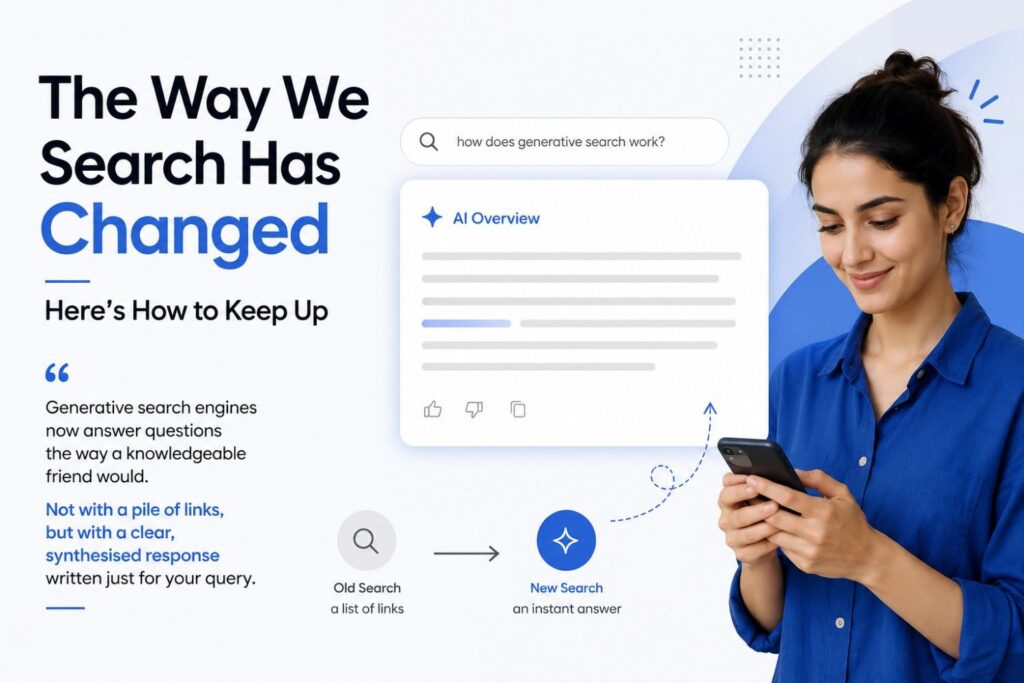
Generative search engines now answer questions the way a knowledgeable friend would. Not with a pile of links, but with a clear, synthesised response written just for your query.
If you’re still searching the old way, you’re getting old-school results. This guide shows you how to actually use generative search engines to get what you’re looking for — faster, smarter, and with less frustration.
What Makes a Generative Search Engine Different?
Classic search works by matching your words to pages. You search. It indexes. You scroll.
Generative search works by understanding what you mean — then composing a response. It reads multiple sources and gives you a single, coherent answer. Tools like ChatGPT Search, Google’s AI Overviews, and Perplexity AI are the main players right now.
The underlying technology is GPT and similar large language models. When people talk about “GPT” in a search context, they’re really talking about this generation of AI that understands language at a level that was science fiction five years ago.
This matters whether you’re a student researching a topic, a marketer planning a campaign, or a business owner trying to understand your competition.
Getting Good Answers: The Art of the Prompt
The quality of what you get out of a generative search engine depends almost entirely on what you put in.
A vague question gets a vague answer. A specific, contextual question gets something genuinely useful.
Here’s a simple framework:
- Who you are — give the engine context about your role or situation
- What you need — be precise about the outcome you want
- Any constraints — format, length, location, level of detail
Example — Vague: “How to do digital marketing?” Example — Strong: “I run a mid-sized clothing brand in India. What digital marketing channels should I prioritise in 2026, and why?”
The second version is worth ten times more.
Using ChatGPT for SEO Work
ChatGPT for SEO has become a real part of how marketing teams operate. Here’s where it genuinely delivers:
- Writing and testing meta titles and descriptions at scale
- Generating topic clusters from a single seed keyword
- Drafting FAQ sections that match how people actually ask questions
- Identifying content gaps when you paste in a competitor’s sitemap
For digital marketing agencies and in-house teams across India — from Bengaluru’s tech startups to Delhi’s e-commerce brands — ChatGPT for digital marketing is a daily-use tool, not an experiment.
How Businesses in India Can Win With Generative Search
Here’s something most businesses haven’t caught onto yet: generative search engines don’t just answer questions — they cite sources. When Google’s AI Overview answers a query, it pulls from websites it considers credible and relevant.
That means your website needs to be AI-citation ready, not just keyword-optimised.
What that looks like practically:
- Clear, structured content — headings, subheadings, direct answers near the top
- Question-based writing — write the way people ask (“How much does SEO cost in India?” vs. “SEO pricing”)
- E-E-A-T signals — author bios, case studies, real business information, verified reviews
- Local specificity — content that mentions your city, region, and real service context
A salon in Hyderabad, a chartered accountancy firm in Ahmedabad, a logistics company in Mumbai — every local business can structure its content to be pulled into AI-generated answers.
What ChatGPT Can’t Do (And Why That Matters)
Let’s be honest about the limits.
ChatGPT and similar tools don’t know what happened last week unless they have live web access. They can hallucinate — confidently stating things that are flat-out wrong. And they have no understanding of your business, your customers, or your brand voice unless you give them that context.
The best way to use these tools: treat them as a capable junior assistant, not an oracle. They’re fast, broad, and surprisingly good at structuring ideas. But the judgement, the strategy, and the final edit? That’s still on you.
FAQ — Everything You Wanted to Know About Generative Search
Q: What is a generative search engine in simple terms? It’s a search tool that reads multiple web sources and writes a direct, summarised answer to your question — instead of just showing you a list of links to click through.
Q: Is ChatGPT a generative search engine? ChatGPT is a generative AI. When it has web search enabled, it acts like a generative search engine. Without web access, it answers from its training data alone — so it may not have current information.
Q: How is GPT related to search? GPT (Generative Pre-trained Transformer) is the underlying technology that powers many AI tools, including generative search engines. When you use ChatGPT, Google Gemini, or Perplexity, you’re interacting with GPT-style models.
Q: Should I change my SEO strategy for generative search? Yes — focus on clarity, authority, and answering real questions. Content that reads naturally, covers a topic thoroughly, and demonstrates real expertise is what generative engines tend to surface and cite.
Q: How do I use ChatGPT for digital marketing without making my content sound robotic? Use it for structure and research, not final copy. Feed it your brand voice, specific audience details, and real examples. Then edit heavily. The more specific your inputs, the less generic the output.
Conclusion
Generative search isn’t coming — it’s already here, and it’s reshaping how people find businesses, make decisions, and consume information online.
The good news: the fundamentals still matter. Helpful content, clear structure, real expertise, and genuine relevance to your audience. The generative layer just makes it more important to get those basics right.
If you’re looking to rethink your content or SEO strategy for how search actually works in 2026, the AuraNext Web Solutions team is here to help]. We work with businesses across India and internationally to build digital presences that perform in the AI-first search landscape.