
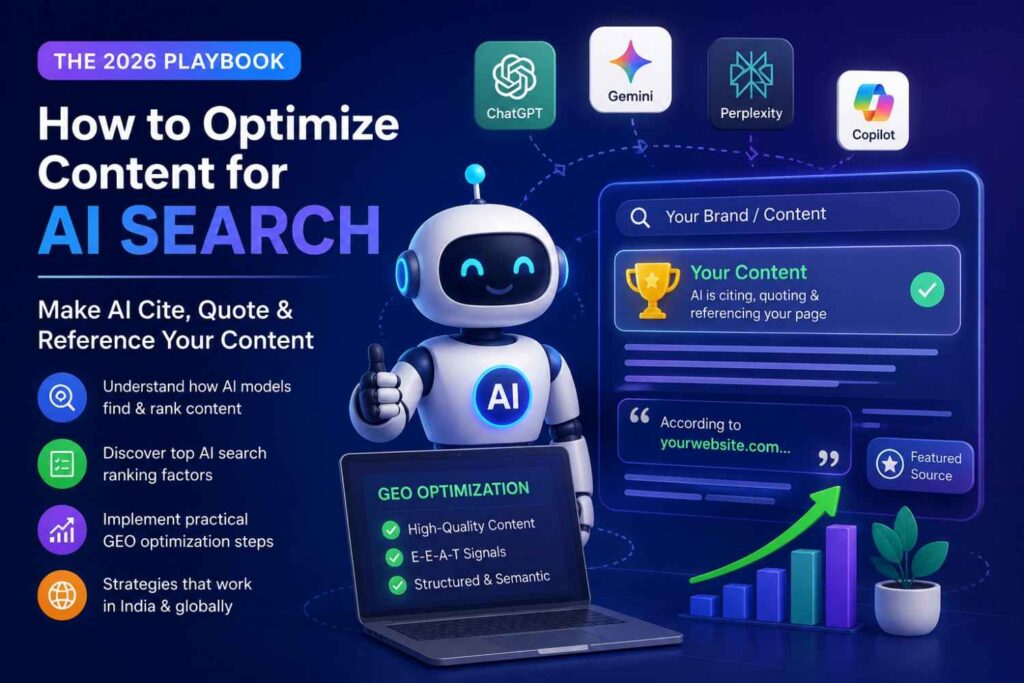
AI search is rewriting the rules of online visibility — and most content isn’t ready.
You published the content. Traffic came in through Google. Then 2025 happened.
Your audience stopped clicking links. They asked ChatGPT. They opened Gemini. They checked Perplexity.
Your content? Nowhere to be found.
AI search doesn’t rank pages — it reads, evaluates, and decides whose content is worth citing. If you’re not built for that, you get skipped.
This guide covers exactly how to optimize for AI search — the ranking factors that matter, and the GEO steps you can take today.
AuraNext’s full-service web solutions are built around exactly these principles.
What Is AI Search?
AI search is not a smarter Google. It is a fundamentally different model. Instead of returning a list of links, tools like ChatGPT Search, Google’s AI Overviews, Gemini, and Perplexity generate a direct answer — synthesised from multiple sources — and credit those sources with citations.
This shift is called Generative Engine Optimization (GEO). Traditional SEO gets you ranked. GEO gets you cited. Both matter now, but GEO is what most businesses are still missing. Understanding Google’s SEO fundamentals is still the foundation — GEO builds on top of it.
| Key Point | AI search reads your content, understands it, summarises it, and tells the user what it found. If your content is well-structured and trustworthy, the AI credits you as a source. If not, it cites a competitor. |
How ChatGPT, Gemini, and Perplexity Choose Sources
Each platform has its own blend of signals, but the core logic is the same: find the most accurate, trustworthy, and clearly written answer — then attribute it.
ChatGPT Search
ChatGPT pulls live web results via Bing and prioritises pages that answer questions directly, use clear heading structure, and demonstrate expertise. Core Web Vitals (speed, stability, responsiveness) also factor in — fast, well-built sites get an edge. AuraNext’s full-stack development service
ensures every site we build meets these technical benchmarks from day one.
Google Gemini & AI Overviews
Gemini leans heavily on Google’s existing quality signals — E-E-A-T, Core Web Vitals, and Knowledge Graph connections. If your site already ranks well in traditional search, you have a solid foundation. Our SEO marketing service covers both traditional and GEO signals so you don’t have to choose between them.
Perplexity
Perplexity is arguably the most citation-transparent platform — it shows users exactly which pages it referenced and why. Content that earns citations here tends to be factual, specific, and well-linked externally. External links from authoritative sources directly strengthen your citation probability across all three platforms.
Top AI Search Ranking Factors
Want to show up in AI-generated answers? These six signals consistently drive citation probability across ChatGPT, Gemini, and Perplexity.
| Factor | What to Do |
| E-E-A-T | Show real experience. Link author bios to credentials. Cite primary sources. AI strongly favours demonstrated expertise over generic claims. |
| Semantic Relevance | Cover the topic fully — not just the target keyword. Answer related questions on the same page using natural language. |
| Authority & Citations | Earn backlinks from Indian publications, global media, and established industry sites. Each citation increases your AI source probability. |
| Structured Data | FAQPage, HowTo, and Article schema help AI engines parse your content with higher confidence. One of the fastest wins available. |
| Content Freshness | Update key pages every 60–90 days with new data or examples. Stale content consistently loses AI citation battles. |
| Brand Trust | Consistent presence across Google Business Profile, social, reviews, and press signals entity verification to AI. |
How to Make Your Content AI-Friendly
Knowing the factors is step one. Here is what to actually do when writing or updating content — whether your audience is in Delhi, Mumbai, Bengaluru, or anywhere globally.
Write for Questions, Not Just Keywords
AI search queries are conversational. Structure H2 and H3 headings as questions and answer them directly in the first two or three sentences underneath. AI models pull these short, direct paragraphs as answer candidates. Every heading in this blog follows that exact principle.
Add Verifiable Facts and Data
Statements backed by data are far more citable than vague claims. Cite primary sources like Google’s Web.dev performance documentation or published research whenever you make a technical claim. This is the kind of trustworthiness AI engines reward. AuraNext embeds this standard into every WordPress site and Shopify store we build — content-ready from launch.
Use Clear, Logical Heading Structure
One H1. Multiple H2s for main sections. H3s for subsections. Never skip heading levels. AI engines parse heading hierarchies to understand what your page is actually about. A broken or inconsistent heading structure is a citation killer — and one of the most common mistakes we see across sites globally.
Implement Schema Markup
Every blog post needs Article schema at minimum. Add FAQPage schema wherever you answer questions, and review the full FAQPage spec on Schema.org to implement it correctly. For service pages, add Service and LocalBusiness schema — especially important for businesses across India. AuraNext’s UI/UX and development team implements schema markup as standard on every project we deliver.
Build Entity Authority
Create and verify your Google Business Profile. Keep NAP (Name, Address, Phone) consistent across all directories. Get featured in industry roundups, news articles, and curated lists. The more AI can verify your real-world existence as an entity, the more it trusts your content — and the more often it cites you. You can see how we apply this for clients across our portfolio.
AI-Friendly Content Checklist:
• Write one direct answer per heading — keep it under 50 words
• Add author name, credentials, and publication date to every post
• Cite 2–3 authoritative external sources per 500 words — see Moz’s backlink guide for authority context
• Install FAQPage schema and Article schema on all blog content
• Update core pages every 60–90 days with fresh data or examples
• Build internal links between related content across your site
• Earn mentions in reputable Indian publications and global industry blogs
• Verify your Google Business Profile and keep NAP consistent across directories
Future of AI Search Optimization
AI search is moving faster than traditional SEO ever did. A few shifts worth preparing for right now:
Multimodal Search Is Coming
Gemini and GPT-4o already process images, audio, and video alongside text. Content strategies that include video transcripts, annotated images with descriptive alt text, and spoken-word content will have broader reach as AI indexes non-text media more reliably. AuraNext’s UI/UX design team builds every interface with visual SEO and accessibility in mind — both of which feed directly into multimodal AI signals.
Personalised AI Answers
AI search engines are beginning to tailor answers based on user history and location. For businesses targeting Indian markets — e-commerce in Bengaluru, SaaS in Hyderabad, agencies in Delhi — location signals and locally relevant content carry increasing weight. Our SEO marketing service includes geo-targeted content strategies built for exactly this environment.
Zero-Click Becomes the Norm
More users get complete answers without visiting any page. Your goal shifts from earning a click to earning a citation. Brand recognition from consistent AI mentions builds trust that eventually drives direct searches and conversions. This is why every site AuraNext delivers — whether Shopify,WordPress, or full-stack — is structured for both traditional and AI visibility from day one.
AI-Resistant Moats
Original research, proprietary data, unique case studies, and genuine expert opinion are the hardest things for AI to synthesise from scratch. These become your highest-value content assets — cited precisely because no one else has them. Browse our client portfolio to see how we help businesses build this kind of lasting digital authority.
Frequently Asked Questions
| Question | Answer |
| What is GEO optimization? | GEO (Generative Engine Optimization) is the practice of structuring content so AI-powered engines like ChatGPT, Gemini, and Perplexity surface it in generated answers, not just blue-link results. |
| How do I appear in AI search results? | Focus on E-E-A-T, write concise factual paragraphs under descriptive headings, implement structured data, earn external citations, and update content regularly. |
| Is E-E-A-T important for AI search? | Yes. AI models heavily favour demonstrated expertise. Author credentials, first-hand data, and trustworthy sourcing directly improve AI citation probability. |
| Does structured data help AI ranking? | Absolutely. FAQPage, HowTo, and Article schema help AI parse your content accurately — one of the fastest GEO wins available. |
| How often should I update content? | Every 60–90 days for priority pages. Fresh data, updated stats, and refreshed dates improve citation ranking against older competing content. |
Wrapping Up
AI search is not replacing SEO — it is expanding what SEO means. The fundamentals still hold: write well, build authority, earn trust. But now you also need GEO-specific practices — structured data, direct Q&A formatting, citation-worthy facts, and entity authority — to stay visible where ChatGPT, Gemini, and Perplexity are becoming the new front page of the internet.
Start with one page. Audit its heading structure, add FAQPage schema, cite two authoritative external sources, and refresh it with something new. That is the first step toward consistent AI citation.
| Ready to Get Cited by AI Search?AuraNext builds SEO-ready websites and content structures designed for modern AI search — from schema to site speed to GEO strategy.→ Talk to Our Team at auranextwebsolutions.com/contactView All Services → |
© 2026 AuraNext Web Solutions · India & Worldwide ·https://auranextwebsolutions.com/contact/