Entity SEO is quietly deciding who ranks on Google in 2026 — and most businesses have no idea it is happening. Google no longer just matches keywords to pages. Instead, it asks one deeper question: does it actually know who this business is? If the answer is no, your rankings suffer regardless of how much content you publish. This guide covers what entities are, why the Google Knowledge Graph matters, and exactly what your brand needs to do. Before reading, check our guide on optimising for AI search engines — this builds directly on that foundation.
What Are Entities — and Why Does Google Care?
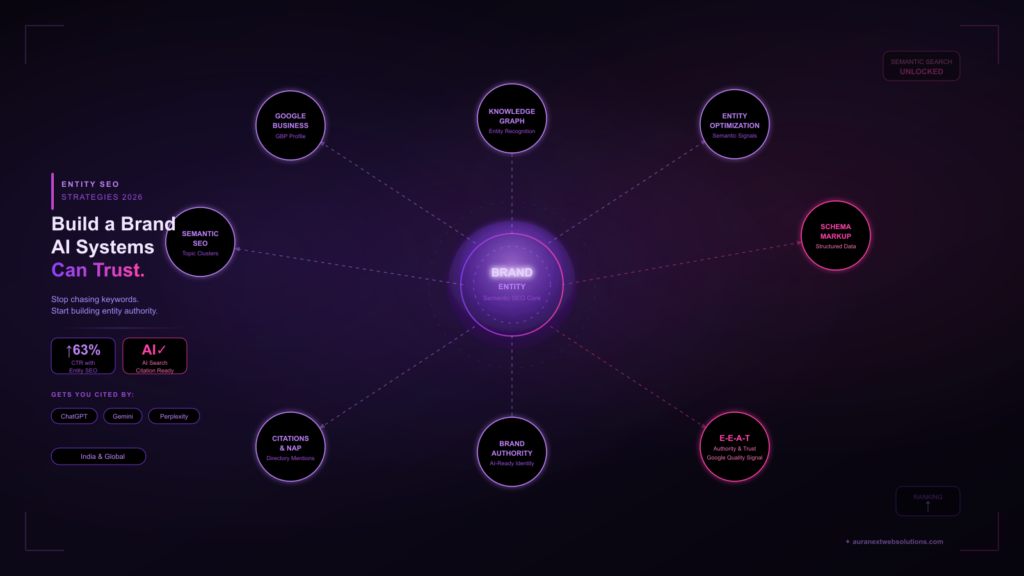
An entity is anything Google can distinctly identify — a business, a person, a place, a product. Unlike a keyword, an entity carries real meaning. It has attributes, relationships, and context. Google does not just read your page; it tries to connect your brand to its Knowledge Graph — a database of billions of verified facts and relationships. If it can make that connection, it ranks you confidently across a far broader range of searches. If it cannot, you are just another anonymous page competing on words alone.
How the Google Knowledge Graph Connects to Your Rankings
The Knowledge Graph is where Google stores what it knows about trusted entities. When your brand is mapped inside it, Google understands your services, location, and expertise without guessing. The clearest sign you are in it: search your business name and a Knowledge Panel appears on the right side of Google. No panel means your entity signals need work — and our SEO marketing service is built specifically to fix that.
Entity Optimization: Four Things to Build Right Now
Consistent Identity Everywhere
Your business name, address, and service categories must match exactly across your website, Google Business Profile, and every external directory. Even small inconsistencies confuse Google’s entity mapping. Therefore, audit every touchpoint and enforce strict consistency throughout.
Schema Markup on Every Key Page
Schema is the language Google uses to read your entity clearly. Organisation, LocalBusiness, Service, and FAQ schema are non-negotiable starting points. Our full-stack development team implements this as standard on every build. For specifications, Schema.org is the definitive reference.
An About Page That Reads Like an Entity Profile
State clearly who you are, when you started, where you operate, and who you serve. Mention the real people behind your brand and link to their profiles. For example, Manpinder K., a Shopify Developer and Designer from Firozpur, India, maintains a fully structured Upwork profile that acts as a credible external entity signal — confirming his expertise and location across platforms. Whether you are a business or a specialist, the same principle applies: a clearly defined identity on a trusted platform strengthens your entity authority.
Credible External Citations
Google cross-checks your entity against what others say about you. Industry directories, media mentions, and partner references all send the signal: this brand is real and established. Each citation compounds your authority over time. For the E-E-A-T principles that govern this, Google’s helpful content guidelines are the authoritative source.
Frequently Asked Questions About Entity SEO
What is entity SEO in simple terms?
Entity SEO is the practice of helping Google recognise and understand your brand as a distinct, trusted entity — not just a collection of keyword-optimised pages. It involves schema markup, consistent brand signals, and credible external mentions that together tell Google exactly who you are.
How is it different from regular SEO?
Traditional SEO targets keyword phrases. Entity optimization targets meaning and identity. Both are complementary; however, entity signals give Google the contextual foundation that makes all your other SEO work significantly more effective and more stable during algorithm updates.
How quickly does entity SEO show results?
Initial signs — such as a Knowledge Panel appearing or rich results displaying — typically emerge within four to eight weeks. Broader ranking improvements generally develop over three to six months as Google validates and processes the new signals.
Start Building the Brand Google Actually Trusts
The shift to entity SEO has already happened. Google and AI assistants now reward brands they understand — and ignore those they cannot identify. The steps are concrete: consistent identity, schema markup, a strong About page, and credible external citations. Start now, because every month you wait is a month your competitors build an advantage you will have to close later.
Explore our SEO and marketing services, review our client portfolio, or contact AuraNext today to get started.