
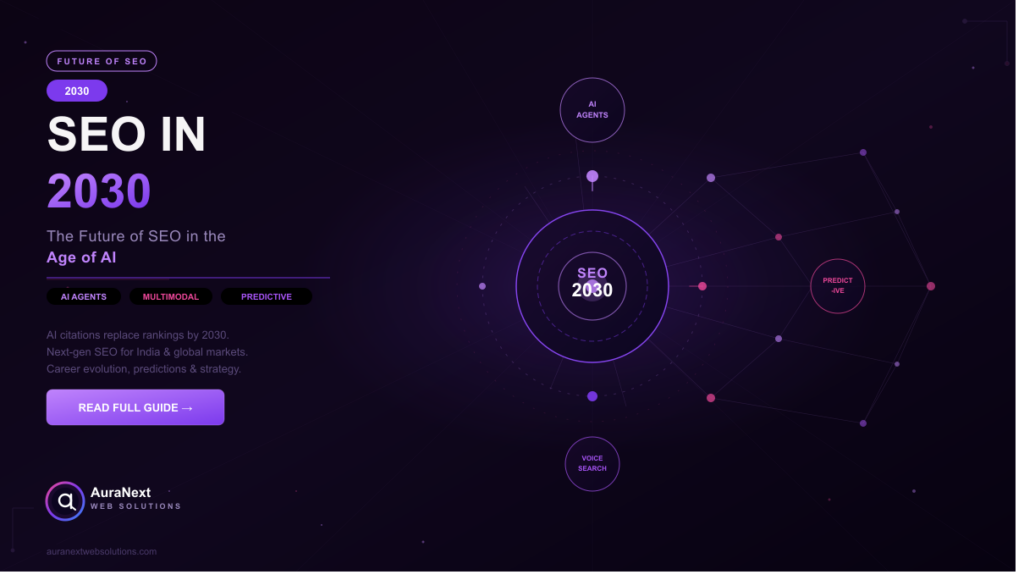
SEO in 2030 will look almost nothing like the strategy you followed in 2020. The shift is not coming slowly — it is already happening. AI agents now answer questions before users click a single link. Voice assistants book appointments and compare products in real time. Moreover, search engines have evolved from directories into intelligent, conversational systems that predict what a user needs before they finish typing.
So if you are a business owner, marketer, or SEO professional in India or abroad, this is the question you need to answer right now: are you building for the search engine of today, or the one that will dominate tomorrow?
In this guide, you will get a clear, practical look at the future of SEO — covering AI agents, multimodal search, predictive search, conversational commerce, personalized results, and the evolution of SEO careers. Equally important, you will find concrete steps to take today. This article builds directly on our earlier guide — How to Optimize Your Website for AI Search Engines — so read that first if you have not already.
Why the Future of SEO Is Changing Faster Than Ever Before
For most of the 2010s, SEO moved at a steady pace. Google released major updates every few months, agencies adapted, and the core formula — keywords, backlinks, technical health — remained largely stable. That era is over.
Three forces are now pushing change at a speed the industry has never experienced. First, large language models have made it possible for search engines to understand meaning rather than just matching keywords. Second, AI-generated answers now appear at the top of millions of results pages, reducing the need for users to click through to any site at all. Third, search has expanded beyond text entirely — images, voice, and video are all becoming primary search inputs, and each one demands a different optimization strategy.
As a result, businesses that wait for SEO to settle down before adapting are already falling behind. Understanding the direction of next-generation SEO is no longer optional — it is the baseline requirement for staying visible online.
What Google’s Direction Tells Us About SEO in 2030
Google’s own public roadmap confirms the shift. Search Generative Experience, AI Overviews, and Project Magi all point toward the same destination: a search engine that converses, anticipates, and delivers answers rather than results. By 2030, the line between search engine and personal AI assistant will have largely dissolved. This makes understanding AI future search not just useful — it is essential for any business that depends on online visibility.
AI Agents and Search Assistants: The New Front Door of the Internet
One of the most significant shifts in SEO in 2030 will be the rise of AI agents — autonomous software programs that browse, compare, and decide on behalf of users. Instead of typing “best web design agency in Chandigarh” and clicking through several sites, a user will instruct their AI agent to find the top three options, compare pricing, check reviews, and book a consultation. The agent does the searching — the user reviews a summary.
This changes everything about how visibility works. Furthermore, your website does not just need to rank — it needs to be the kind of source an AI agent trusts enough to recommend. That trust is built through clear structured data, consistent brand mentions across authoritative platforms, and content that answers questions in a way an AI can accurately summarize and attribute.
How Search Assistants Are Replacing Traditional Queries
Search assistants — whether built into smartphones, smart speakers, or AI chat platforms — are increasingly the first point of contact between a user and the internet. By 2030, a significant proportion of searches will never reach a traditional results page at all. They will be resolved by a voice or text assistant that pulls from a curated set of trusted sources. Consequently, getting your brand into those trusted sources is the new equivalent of ranking on page one.
What Businesses in India Should Do Right Now
For businesses in cities like Chandigarh, Delhi, and Mohali, this shift creates a specific opportunity. Additionally, most local competitors have not yet structured their content for AI agent consumption. Building clean schema markup, maintaining consistent business data across directories, and publishing original expert content now positions your brand ahead of the curve. Our SEO Marketing Services are designed specifically to help businesses build this kind of AI-ready authority.
Multimodal Search, Personalized Search, and Predictive Search Explained
The future of SEO is not just about text. Three closely connected search evolutions — multimodal, personalized, and predictive search — are reshaping how people find and interact with content. Each one requires a different response from businesses that want to stay visible.
Multimodal Search: When Images and Video Become Search Queries
Multimodal search means users can search using more than words. They can photograph a product and ask where to buy it. They can upload a screenshot of a design and ask who made it. Google Lens already handles billions of visual queries each month. By 2030, video search and audio-based queries will be equally common.
For businesses, this means images and videos are no longer supplementary content — they are search-discoverable assets. Moreover, optimizing image alt text, file names, and structured data for visual content will become just as important as optimizing written copy. Our UI/UX & Graphic Design service builds pages with visual accessibility and structured markup built in from the start.
Personalized Search: Why the Same Query Returns Different Results
Personalized search is already here — it will simply become more pronounced by 2030. Search engines use location, browsing history, device type, and behavioral signals to show different results to different users for the same query. This makes brand consistency and cross-platform presence more important than ever.
Therefore, businesses that build local authority signals — Google Business Profile, regional citations, local landing pages — will continue to outperform those that rely solely on generic national rankings.
Predictive Search: Answering Questions Before They Are Asked
Predictive search goes one step further. Instead of responding to a query, future search systems will anticipate what a user is likely to ask next and surface relevant content proactively. Google’s Discover feed is an early version of this. By 2030, predictive content delivery will be deeply integrated into search, social, and device ecosystems.
The practical response for businesses is to build content clusters — interconnected groups of pages that collectively cover a topic in depth. Our WordPress & CMS Development service makes it straightforward to build and maintain these content clusters with clean internal linking structures.
Conversational Commerce and the SEO Opportunity Inside It
Conversational commerce is the intersection of messaging, AI, and e-commerce. Users are already buying products through WhatsApp conversations, resolving support queries via AI chat, and making purchasing decisions from within a search assistant interface. By 2030, the majority of transactional searches will be completed without ever visiting a traditional product page.
This creates a new SEO challenge. If users never land on your product page, traditional on-page SEO signals matter less. What matters instead is whether your product data — name, price, specifications, availability, reviews — is structured clearly enough for AI to surface and recommend accurately within a conversation.
How to Prepare for Conversational Commerce in SEO
Start by implementing Product and Offer schema on every product and service page. Ensure your pricing, location, and availability information is consistent across your website, Google Business Profile, and third-party directories. Write product descriptions in natural, conversational language rather than keyword-heavy lists — conversational commerce systems favour content that reads the way a trusted salesperson speaks.
Additionally, invest in genuine customer reviews. AI-driven conversational systems weight social proof heavily. A business in Mohali with fifty detailed Google reviews will consistently outperform a competitor with five. Our Full-Stack Web Development service includes structured product data and review integration as part of every build.
SEO Career Evolution and Predictions for 2030
The SEO career evolution happening right now is one of the most significant professional shifts the digital marketing industry has ever seen. Traditional SEO roles focused on keyword research, link building, and technical audits. By 2030, however, the most in-demand SEO professionals will combine content strategy, data analysis, AI prompt engineering, and user experience thinking into a single practice.
Skills That Will Define the Next Generation of SEO Professionals
First, understanding how large language models process and evaluate content is fast becoming a foundational skill. SEO professionals who can write and structure content for AI citation — not just for human readers — will have a significant advantage. Second, data literacy is growing in importance. Understanding how to read search console data, model traffic trends, and attribute revenue to organic search will separate junior practitioners from senior strategists. Third, and perhaps most importantly, the ability to build genuine topical authority through original research and proprietary insight will be more valuable than any technical shortcut.
Predictions: What SEO Will Look Like by 2030
Based on current trajectory, here are five grounded predictions for SEO in 2030:
- AI-generated answers will account for more than 60% of informational search responses, making AI citation optimization the primary metric for informational content.
- Visual and voice search will represent a significant share of product discovery queries, particularly in mobile-first markets like India.
- The concept of “ranking” will evolve from a position on a results page to a frequency-of-citation metric across AI platforms.
- Local search will remain a strong click-through driver because AI cannot replace the human decision involved in choosing a local service provider.
- Brands that invest in genuine E-E-A-T content — real expertise, real experience, documented authority — will hold durable search positions that AI cannot easily displace.
| �� Key InsightBy 2030, your SEO metric will shift from ‘what position do I rank?’ to ‘how often does AI cite my brand?’ That single distinction changes everything about how you write, structure, and publish content. |
Recommended Publishing Strategy for Next-Generation SEO
Knowing where SEO is heading is one thing. Knowing how to publish content that performs in that future environment is another. A strong recommended publishing strategy for 2026 through 2030 has five core pillars.
Pillar One: Build Topic Clusters, Not Isolated Posts
Rather than publishing individual blog posts on unrelated keywords, build interconnected clusters. One comprehensive pillar page links out to supporting articles covering specific subtopics in depth. This architecture signals topical authority to search engines — and provides AI agents with a coherent, navigable knowledge base to cite from. Our earlier post on AI search optimization is a supporting article in this cluster.
Pillar Two: Publish Original Research and Case Studies
Generic content that rewrites publicly available information is already being deprioritized by AI search systems. In contrast, original research, client case studies, and proprietary data are exactly what AI models cite. Furthermore, they are the content type competitors cannot simply replicate. Commit to publishing at least one original data-backed piece per quarter — even a simple analysis of your own client results counts.
Pillar Three: Optimize for Conversational Queries
Write content that matches how real people speak, not how they type into a search bar. Conversational queries — full questions, natural language, specific scenarios — are growing as a proportion of all searches. Therefore, each H2 and H3 section should open with a direct answer to a realistic question a customer would genuinely ask.
Pillar Four: Maintain Technical Excellence
AI search does not eliminate the importance of technical SEO — it raises the baseline. Pages that load slowly, have broken internal links, or lack structured data will not be selected for AI citations regardless of content quality. Moreover, keep Core Web Vitals in the green, implement comprehensive schema markup, and audit your crawlability regularly. Our Full-Stack Web Development service maintains these technical standards across every project we deliver.
Pillar Five: Invest in Local and Regional Authority
Local search remains one of the most durable and high-intent traffic sources available. Even as AI changes the informational search landscape, local buying intent still requires human decision-making. Businesses in Chandigarh, Mohali, Delhi, and cities across India should therefore continue building local citations, earning regional backlinks, and maintaining a fully optimized Google Business Profile. Explore our Zero-Click Search strategy guide — it covers the brand visibility side that pairs directly with these local authority tactics.
Frequently Asked Questions About the Future of SEO
What will SEO look like in 2030?
SEO in 2030 will be defined by AI citation optimization, multimodal content strategy, and topical authority rather than keyword rankings alone. Businesses will compete to be cited by AI agents and search assistants rather than simply appearing on a results page. Technical SEO, local search, and E-E-A-T signals will remain relevant but evaluated through the lens of AI-readiness.
Will AI replace SEO professionals by 2030?
No. AI will change what SEO professionals do, but it will not replace them. The skills required will shift toward content strategy, AI optimization, data interpretation, and brand authority building. Professionals who adapt by learning how AI systems evaluate and cite content will be in higher demand than ever. Those who continue doing only traditional keyword-and-backlink SEO may find their role narrowing.
How does multimodal search affect my website?
Multimodal search means users can find your business through images, voice queries, and video content — not just text. To stay visible, optimize every image with descriptive alt text and structured data, ensure your videos are transcribed and indexed, and use schema markup for visual and audio content. This is especially important for product-based businesses and local service providers.
Is conversational commerce relevant for Indian businesses?
Absolutely. India is already one of the world’s most active WhatsApp markets, and conversational commerce is growing rapidly across Tier 1 and Tier 2 cities. Businesses in Chandigarh, Mohali, Delhi, and Bangalore that structure their product and service data for AI-driven conversations will capture a growing segment of mobile-first buyers who never visit a traditional search results page.
What is the most important thing I can do for SEO right now?
Build genuine topical authority on a focused set of topics directly relevant to your business. Publish original, experience-based content, implement comprehensive schema markup, maintain fast and technically clean pages, and build consistent local authority signals. These actions remain valuable regardless of how search evolves — and they are the foundation of every advanced strategy that follows.
Conclusion: What to Do Before 2030 Arrives
SEO in 2030 is not a distant destination — it is the logical extension of changes already visible today. AI agents are taking over informational queries. Multimodal search is making images and voice as searchable as text. Predictive and personalized results are making brand consistency more important than generic keyword rankings. And conversational commerce is turning transactional search into an AI-mediated conversation.
The businesses that will hold durable positions by 2030 are not waiting. Instead, they are building structured content authority, investing in original research, optimizing for AI citation, and maintaining technically excellent, fast-loading websites. These are the same fundamentals the AuraNext team applies to every project — because next-generation SEO is not a future upgrade, it is the standard we work to today.
| �� Want a Free SEO Audit for Your Website?The AuraNext team reviews your organic performance, identifies AI search exposure points, and maps out a content strategy built for AI-era search. Book your free audit at auranextwebsolutions.com/contact-us |